
Massage guns are now almost as common in gym bags as resistance bands and the banana somebody forgot to remove last Tuesday. They promise a convenient dose of percussion before or after training, and the good ones can make a short recovery routine feel easier to maintain. The less-good ones sound like power tools and vibrate your hand into another dimension.
This guide compares three recognizable options at different prices: Therabody’s Theragun Relief, the compact Hyperice Hypervolt Go 2, and the value-focused Bob and Brad C2. We will look at handling, speed, attachments, noise, portability, and cost. More importantly, we will explain what a massage gun can realistically do—and what it cannot—so your recovery plan does not become five minutes of aggressive poking followed by complete confusion.
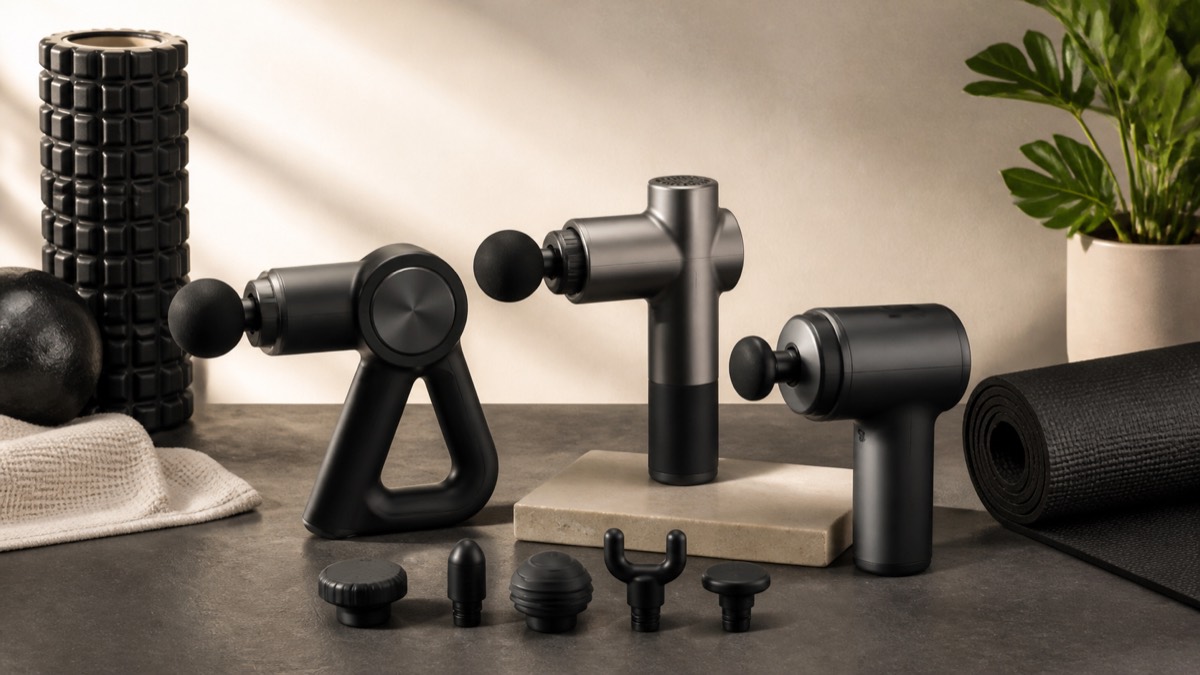
Massage gun comparison table
| Model | Typical price | Best for | Pros | Cons |
|---|---|---|---|---|
| Theragun Relief | About $149 | Easy, comfortable everyday use | Ergonomic triangular handle, simple controls, trusted ecosystem | Fewer advanced settings, premium price for a gentle model |
| Hypervolt Go 2 | About $129–$159 | Travel and compact recovery | Portable, clean design, straightforward speeds | Two attachments, conventional handle may fatigue the wrist |
| Bob and Brad C2 | About $90–$130 | Value-focused beginners | Multiple attachments, competitive performance, carrying case | Less refined feel, more settings than some people need |
Why massage guns are still trending
Percussion devices fit modern fitness culture perfectly: they are portable, visible, satisfying to use, and easy to demonstrate. Unlike a mobility program, they do not require learning six exercise names or lying on the floor while your dog investigates. Press a button, place the attachment on a large muscle, and the product immediately feels active.
Convenience is a legitimate advantage. A tool you use for a few sensible minutes may be more valuable than an elaborate routine you always postpone. But the dramatic sensation can encourage overuse. More pressure is not automatically more recovery, and pain is not proof that the device has located a secret knot containing all your problems.
What does a massage gun actually do?
A massage gun delivers rapid mechanical pulses to soft tissue. People commonly use it during a warm-up to create a temporary feeling of readiness or after training for short-term relief from tightness and soreness. Research on percussion therapy continues to develop, and results depend on the outcome being measured. A massage gun should be viewed as a comfort and preparation tool, not a treatment for injury or a replacement for sleep, nutrition, sensible programming, or professional care.
Temporary changes in sensation or range of motion can be useful. If using the device helps you move comfortably into a warm-up, that is a practical win. It does not mean tissue has been “broken up,” toxins have been blasted away, or the attachment has negotiated directly with your fascia. Be skeptical of explanations that sound like construction work.
How we compared the best massage guns
Headline stall force and speed count do not tell the full story. We prioritized comfortable handling, useful attachments, accessible controls, noise, battery practicality, size, and support. A powerful device is frustrating if you cannot comfortably reach your upper back. Ten speed levels are not impressive if you use exactly two. The best massage gun makes safe, moderate use easy.
Theragun Relief: best for easy everyday handling
Theragun Relief is positioned as Therabody’s gentler, simpler model. Its biggest advantage is the brand’s triangular multi-grip handle, which gives you more ways to hold the device and can reduce awkward wrist angles. It uses a one-button control and includes a small selection of attachments aimed at general use. For someone who wants an approachable device rather than an advanced recovery console, the simplicity is welcome.
The Relief does not offer the deep customization or power of Therabody’s more expensive models. That is not necessarily a weakness for beginners. Many users need a comfortable tool for calves, quadriceps, glutes, and shoulders—not a machine determined to reach the center of the earth. At around $149, however, you are paying for design, handling, and brand support rather than the largest specification numbers.
Pros: excellent grip options, easy controls, gentle learning curve, USB-C charging, and an established app and accessory ecosystem.
Cons: limited advanced control, relatively high price for entry-level power, and fewer included attachments than some budget kits.
Best for: beginners, older users, and anyone who values comfortable handling over maximum intensity.
Hypervolt Go 2: best compact travel option
The Hypervolt Go 2 is a smaller member of Hyperice’s percussion line. It typically includes two practical attachments and three speed settings, keeping the experience uncomplicated. Its compact frame is easier to pack than a full-size device, making it attractive for travelers, runners, and people who want a massage gun that does not occupy half a gym bag.
The conventional vertical handle is familiar but offers fewer holding positions than Theragun’s triangle. Reaching the middle back may require flexibility or another person. The two attachments cover broad everyday needs, although shoppers who enjoy specialized heads may find the selection sparse. At roughly $129 to $159, its value depends on how much you prioritize portability and the Hyperice ecosystem.
Pros: compact size, simple three-speed operation, clean build, useful flat and bullet-style attachments, and travel-friendly weight.
Cons: limited attachment variety, traditional handle geometry, and a price above many feature-rich budget devices.
Best for: travelers and gym-goers who want a reliable compact tool with minimal setup.
Bob and Brad C2: best value
Bob and Brad built a large online following around physical-therapy education and expanded into affordable recovery products. The C2 commonly includes several attachments, multiple speed settings, a carrying case, and competitive percussion for less than premium-brand models. It is the obvious option for buyers who want to experiment without paying mostly for industrial design.
The device can feel less refined, and the number of attachments may create an illusion that every muscle needs its own tiny hat. In practice, most people rely on a soft ball for large areas, a flat head for general use, and a smaller head for precise work around—not on—sensitive structures. Still, having options and a case at roughly $90 to $130 creates strong value.
Pros: competitive price, several attachments, multiple speeds, portable case, and enough performance for typical home use.
Cons: less premium finish, busier controls, and long-term support or accessory availability that may not match larger ecosystems.
Best for: budget-conscious users who want a complete starter kit.
Massage gun attachments explained
Ball attachment
A soft or medium ball is the safest starting point for large muscles such as the quadriceps, hamstrings, glutes, calves, and upper back. It spreads pressure across a broader area and is usually the attachment people use most. Begin here before deciding you need something pointier.
Flat attachment
A flat head provides broad contact with a firmer feel. It can work well on dense muscle groups when the ball feels too soft. Keep the device moving slowly and avoid pressing it into bones or joints.
Bullet attachment
The bullet concentrates force into a small area. That makes it easy to overdo. Use low intensity, short duration, and careful placement on suitable muscle tissue. It is not designed for the spine, front or side of the neck, joints, or any area with altered sensation.
Fork attachment
Forked heads are often marketed for areas around the spine or Achilles tendon, but careful positioning is essential. Never run the device directly over the spine or bones. For most beginners, the ball attachment is simpler and more forgiving.
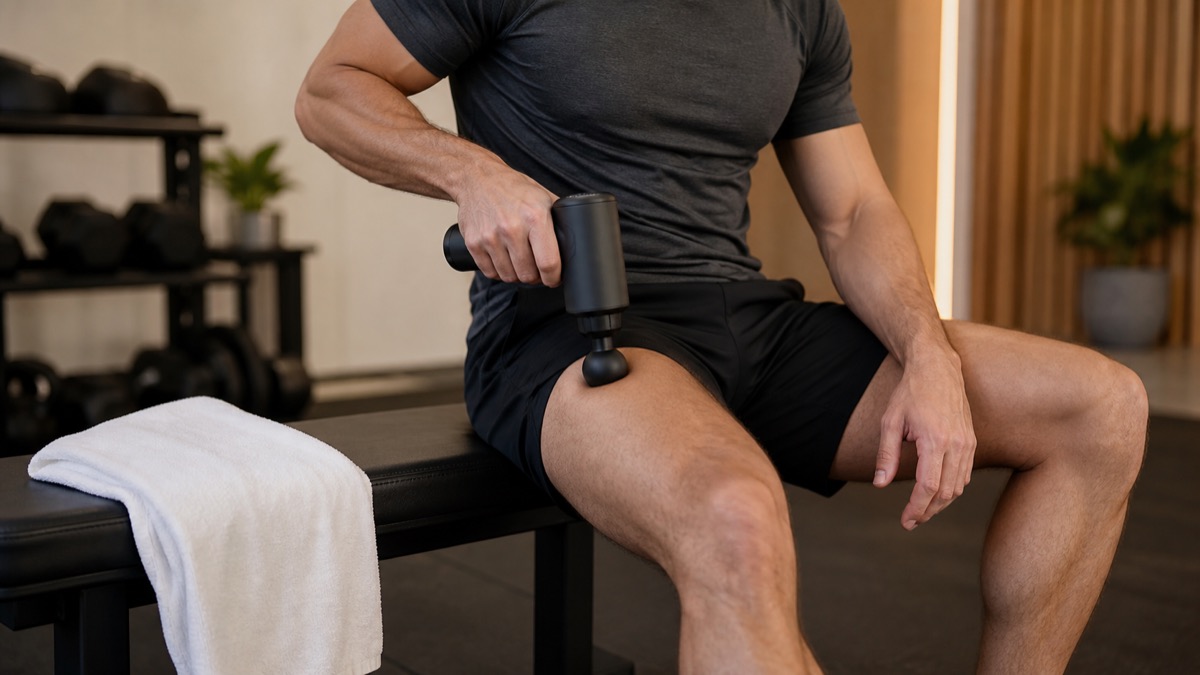
How to use a massage gun before a workout
Use a low or moderate setting for approximately thirty to sixty seconds over each large muscle you plan to train. Keep the attachment moving and use light pressure. Follow with an active warm-up and practice sets of the actual exercise. The device may help you feel ready, but it cannot rehearse squat technique or teach your shoulders where the bar goes.
How to use it after training
After a workout, use comfortable pressure for a short period on major muscles. Two minutes on one area is usually plenty for a beginner. Breathe normally and stop if you experience sharp pain, numbness, tingling, bruising, or symptoms that increase. Recovery should not feel like a competition with the motor.
Areas to avoid
Do not use a massage gun on the head, front or side of the neck, spine, bones, joints, open wounds, rashes, recent injuries, swollen areas, or places with reduced sensation. Avoid known blood clots and areas affected by bleeding or vascular conditions. People who are pregnant, use blood-thinning medication, have neuropathy, osteoporosis, or significant medical conditions should seek professional guidance before use.
Common massage-gun mistakes
The first mistake is pressing harder when a muscle does not immediately relax. The second is remaining on one painful point for too long. The third is using percussion instead of investigating persistent pain. If discomfort repeatedly returns, changes movement, or affects daily life, consult an appropriate clinician. Muting a smoke alarm is not the same as finding the fire.
Another mistake is buying based only on maximum force. Consider grip, noise, weight, case quality, charging, warranty, and replacement attachments. A quieter, lighter device may be used more consistently than a powerful model that wakes the household and makes your hand tired.
Which massage gun should you buy?
Choose Theragun Relief if comfortable reach and simple operation matter most. Choose Hypervolt Go 2 if you want compact travel convenience and only need core attachments. Choose Bob and Brad C2 if you want the strongest feature-to-price ratio and do not mind a less premium finish.
Before ordering, compare the current warranty and return policy. Noise tolerance and handle comfort are personal, and a short home trial can reveal more than a page of specifications. If possible, hold a similar device in a store and test whether you can reach the muscles you plan to use it on.
Battery details deserve a final glance. Manufacturer runtime estimates usually reflect a particular speed and pressure, so hard use may shorten them. A standard USB-C connection is convenient for travel, while a proprietary charger is one more item to remember. Recharge the device before the battery is completely forgotten in a drawer, store it away from extreme heat, and follow the brand’s battery-care instructions. If two models feel equally good in your hand, dependable support and an easy-to-replace charger can be better tie-breakers than one extra speed setting.
Final verdict
Massage guns can be useful because they make a short warm-up or recovery ritual easy to start. They are not mandatory, and they are not medical wands. Theragun Relief offers the most approachable handling, Hypervolt Go 2 is the cleanest compact choice, and Bob and Brad C2 gives beginners the most equipment for the money.
Use whichever device you choose with moderate pressure, sensible placement, and realistic expectations. If it helps you move comfortably and return to consistent training, excellent. If it mostly becomes an expensive way to threaten your quadriceps while watching television, the foam roller may be feeling unfairly overlooked.
Keep learning: recovery-score guide and beginner warm-up routine offer practical next steps on this topic.
Leave a Reply