

Building a gym habit that lasts is less about finding a perfect program and more about making training easy to repeat. Beginners often start with high motivation, then lose momentum when a workout feels too long, too confusing, or too difficult to fit into real life. A better approach is to create a small routine that works on ordinary weeks, not just on your most energetic days.
Start with a realistic gym schedule
Choose two training days each week and put them on your calendar like appointments. Two sessions may sound modest, but it gives you room to learn equipment, recover, and keep your promise to yourself. A Tuesday and Saturday schedule, for example, gives enough space between sessions while still creating a steady rhythm. Once two days feel automatic, you can decide whether a third day fits your life.
Pick a time that has the fewest obstacles. Some people enjoy a quiet morning gym visit; others find that going directly after work prevents the couch from ending the plan. There is no universally best training time. The best time is the one you can protect most weeks.
Make the first 10 minutes easy
Many people skip the gym because they imagine an entire demanding workout before they have even left home. Shrink the starting point. Your only job at first is to arrive, change into comfortable clothes, and do five minutes of gentle warm-up movement. Once you are there, you can choose a short strength session. On a genuinely busy day, completing the warm-up still counts as protecting the habit.
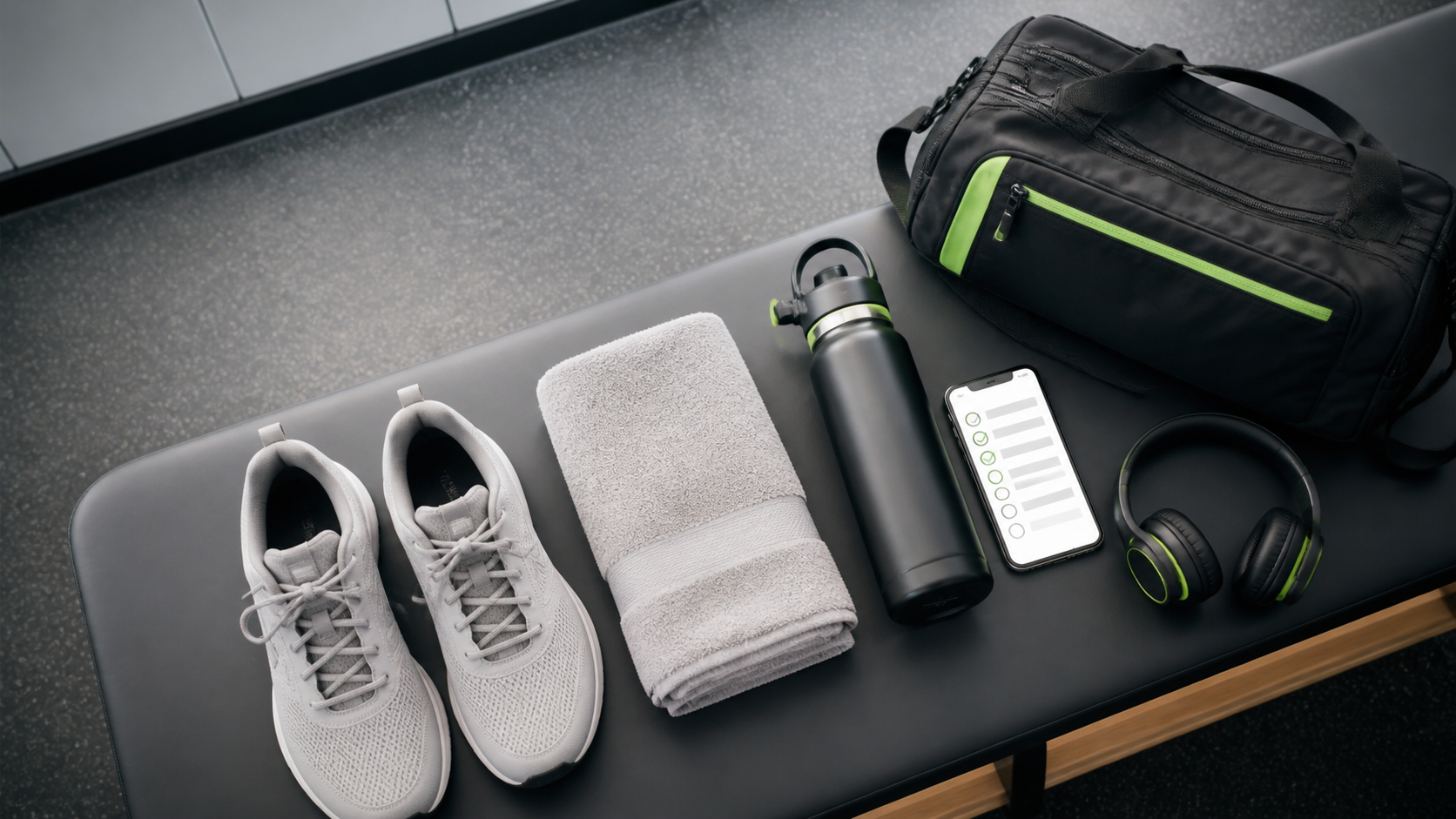
Pack your gym bag the night before. Keep shoes, water, headphones, and a small towel in one place. Reducing small decisions removes friction, especially when your motivation is low.

Use a repeatable full-body routine
A simple routine keeps you from wandering around the gym or comparing yourself with other members. Choose one lower-body movement, one pushing movement, and one pulling movement. Machines are useful for beginners because the setup is predictable and the path of movement is easier to learn. You might use a leg press, chest press, and seated row for two sets each, resting about a minute between sets.
Use a weight that lets you move slowly and finish every repetition with control. You do not need to train to failure or finish exhausted. The goal is to practice, record what you did, and come back ready for another session. Ask a qualified trainer for help adjusting a machine if you are unsure.
Track the small wins
Use a notes app to record the date, exercises, sets, repetitions, and weight used. This creates proof that you are moving forward even when changes are not obvious in the mirror. Progress can mean one additional repetition, a cleaner setup, a slightly heavier weight, or simply showing up during a stressful week.

Plan for missed workouts
Missed sessions are normal. Travel, deadlines, family events, and poor sleep all happen. The mistake is treating one missed workout as proof that the plan failed. Instead, use a simple rule: never miss twice if you can help it. If you skip Wednesday, return on your next planned day or do a short session when you can.
Avoid trying to “make up” for a missed session with an overly hard workout. That usually increases soreness and makes the next visit less appealing. Return to the normal plan, use sensible weights, and let consistency do its work.
Build an identity, not a streak
It is helpful to think of yourself as a person who trains regularly rather than someone chasing a temporary challenge. That identity is built through ordinary actions: bringing your bag, completing a warm-up, practicing good form, and returning after interruptions. Your sessions do not need to be perfect to be valuable.
Celebrate practical milestones. Your first month of two weekly gym visits is a real achievement. So is learning the names of machines, asking for help, or feeling less nervous walking through the door. These changes create confidence that carries into the next phase of your fitness journey.
Final thought
The most effective gym habit is the one that fits your life today. Begin with two manageable sessions, keep your plan simple, and focus on controlled movement. Over time, a routine that once felt unfamiliar can become a reliable part of your week.
Keep learning: how often beginners should train and beginner three-day workout plan offer practical next steps on this topic.
Use a two-level workout plan
Create a normal workout and a minimum workout. Your normal session might last 45 minutes. The minimum version might be a warm-up plus one set each of leg press, chest press, and seated row. On difficult weeks, completing the minimum protects the routine without pretending every day has equal energy.
| Situation | Minimum version | Normal version |
|---|---|---|
| Busy workday | 10–20 minutes and three familiar exercises | Full planned workout |
| Low motivation | Arrive and complete the warm-up | Continue when energy improves |
| Returning after a break | Reduce sets and weights | Rebuild over several sessions |
The minimum is not punishment or a loophole. It is a planned option that prevents an all-or-nothing decision. If you are sick, injured, or have concerning symptoms, rest and seek appropriate guidance instead of forcing a minimum session.
Make your environment support the habit
Choose a gym that is easy to reach, keep your bag visible, and decide what you will do before arriving. Save the routine on your phone. Put training days on the calendar and include travel time. The fewer decisions required at 5:30 p.m., the less opportunity your brain has to propose a surprisingly urgent sofa appointment.
Use our beginner gym-bag checklist and first-day gym checklist to remove practical friction.
Review the habit every four weeks
Ask three questions: How many planned sessions did I complete? What repeatedly made attendance easier? What repeatedly got in the way? Adjust the schedule before assuming you need more discipline. Moving a workout from Friday evening to Saturday morning can be more effective than downloading another motivational wallpaper.
Progress the training only after attendance feels reasonably stable. Add one set, a small weight increase, or a third weekly visit—not all three together. A manageable plan gives you clear information about what your body and schedule can support.
When motivation disappears
Expect motivation to change. Use a start ritual: put on training clothes, drink water, open the saved workout, and begin the warm-up. Decide whether to continue after those steps. This separates “I do not feel excited” from “I should not train today.”
If gym anxiety is the obstacle, visit during a quieter time, ask staff for a tour, or bring a supportive friend. Confidence often follows repeated exposure; it does not have to arrive before your first visit.
Leave a Reply