
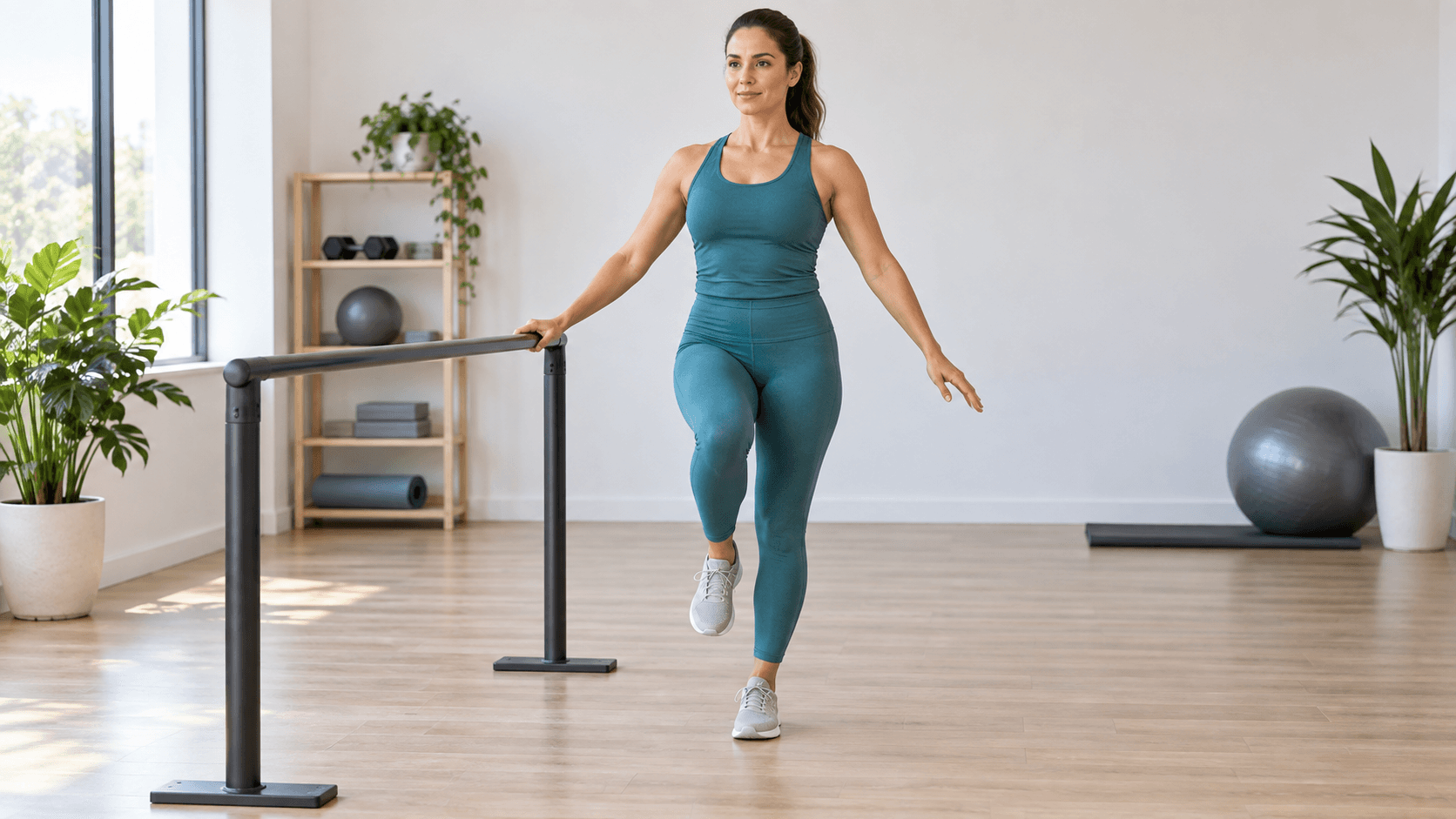
Balance and core exercises for beginners do not need a wobble board, a complicated pose, or the courage to fall over in front of the entire gym. A stable surface, a little space, and a few controlled movements can give you a practical place to start.
This routine combines supported standing balance with simple floor and wall exercises. The aim is to practice control, not to collect the longest plank time in your group chat. You should finish feeling that you learned something about movement, rather than wondering why your living-room rug suddenly feels like a mountain.
Balance, flow, and core strength appear among the top five categories in ACSM’s 2026 fitness trends. This guide turns that timely interest into an approachable session. The routine is an illustrative option for generally healthy adults, with easier choices included; it is not rehabilitation or a personalized fall-prevention program.
What are balance and core training?
Balance involves controlling your position as you stand and move. Core training develops the muscles and coordination involved in controlling your trunk. The two overlap in many activities, but they are not identical. You can practice supported balance without doing a floor exercise, and you can train your trunk while lying down.
For a beginner, the useful focus is a manageable challenge you can repeat with control. That may mean keeping fingertips on a counter during a standing exercise or using a wall for a plank. Support is a tool, not cheating. It lets you practice the intended task without spending the whole session trying to avoid falling.
You also do not have to feel a dramatic burn for a movement to be worth practicing. Notice steadiness, breathing, and whether you can repeat the movement comfortably. A routine can be productive while remaining pleasantly unphotogenic.
Before you begin
Clear the floor and choose a stable support, such as a fixed counter or sturdy rail. Avoid a rolling chair, lightweight table, or object that can tip. Wear footwear that feels secure for standing work. If you use a mat, make sure it does not slide.
Choose a space where you can move your arms and legs without hitting furniture. Keep pets and loose objects out of the immediate area. A curious dog is delightful company but a questionable piece of balance equipment.
If you have dizziness, significant balance problems, recent falls, a recent operation, or an injury that affects these movements, get individualized advice before trying the routine. Stop for sharp pain, dizziness, chest discomfort, or other concerning symptoms. You do not need to finish a set to make the session count.
The 15-minute session at a glance
Use the time as a loose container. Spend around two minutes preparing, ten minutes practicing the movements, and three minutes resting, repeating an easy choice, and recording what felt comfortable. The transitions are included. You are not racing a kitchen timer.
| Part | Movement | Beginner approach |
|---|---|---|
| Prepare | Easy marching and comfortable shoulder movement | About two minutes |
| Standing | Supported weight shifts | Five slow shifts each way |
| Standing | Supported narrow stance | Two brief comfortable holds |
| Core | Wall plank | Two short holds with normal breathing |
| Core | Supine heel slides | Five controlled repetitions per side |
| Core | Bird-dog preparation | Five small arm or leg reaches per side |
These amounts are examples, not compulsory targets. Start with fewer repetitions or shorter holds when appropriate. Rest between movements. If floor work is uncomfortable or getting down and up is difficult, keep the session standing and use the wall variation while seeking advice about suitable alternatives.
1. Supported weight shifts
Stand beside a sturdy support with your feet comfortably apart. Rest your fingertips or hand on it. Slowly move a little more weight toward one foot, then return to the middle. Repeat toward the other side without lifting your feet.
Keep the movement small at first. Your goal is to notice how pressure changes through your feet while your body stays controlled. Avoid throwing your hips sideways or leaning far enough that you need to catch yourself.
Try five shifts each way, then pause. To make the movement easier, keep more hand support and reduce the distance. To make it slightly more challenging later, use lighter support while keeping the same controlled range. Change only one thing at a time.
2. Supported narrow stance
Stand near your support and bring your feet a little closer together than usual. Keep your eyes open and look at a fixed point ahead. Breathe normally while noticing how much support you need. Start with a brief comfortable hold rather than chasing a particular number of seconds.
If that feels steady, a later variation is a small staggered stance with one foot slightly ahead of the other. You do not need to place both feet on an imaginary tightrope. Keep enough width to feel secure, and hold the support whenever needed.
Do not close your eyes or move onto an unstable surface to make the exercise harder. Those changes are unnecessary for this beginner routine and can substantially increase difficulty. Progress by improving control first.
3. Wall plank
Face a wall and place your forearms against it at a comfortable height. Step your feet back slightly so your body leans toward the wall. Keep your trunk controlled and breathe. The position should feel manageable, with no need to arch your back or push your head forward.
Begin with a short hold, then step closer and rest. If it feels too difficult, stand nearer the wall. If your shoulders or wrists are uncomfortable, stop and adjust rather than forcing the position. The intended challenge is not joint pain.
As you gain confidence, you can increase the lean a little, provided the movement remains comfortable. Do not rush to the floor simply because a floor plank looks more official. A wall gives you a useful way to regulate effort.
4. Supine heel slides
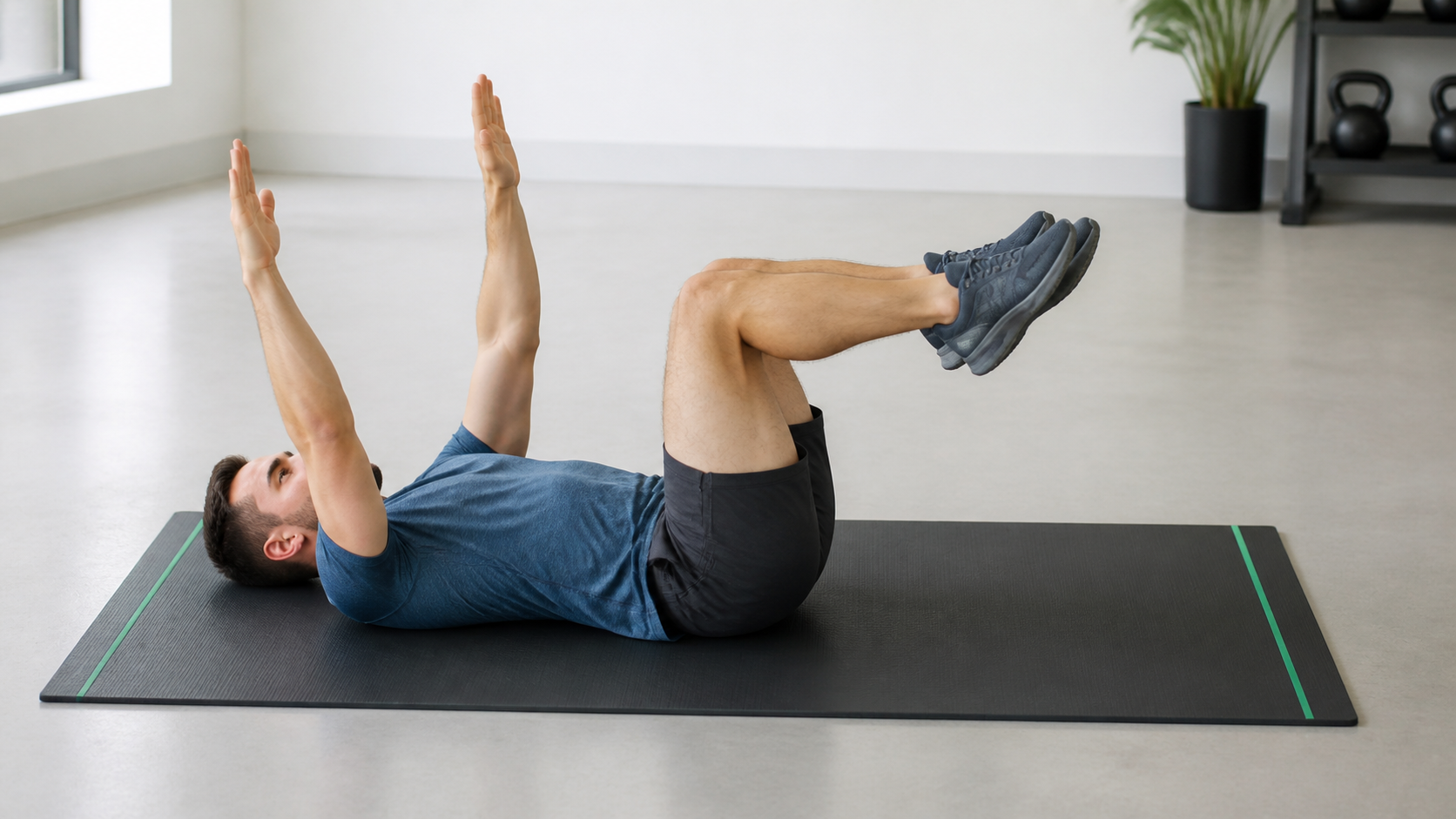
Lie on your back with knees bent and feet resting on the floor, if that position is comfortable. Slowly slide one heel a short distance away, then bring it back. Alternate sides. Keep the range small enough that you can control your trunk and breathe without straining.
This is a simple way to practice moving a leg while maintaining a comfortable torso position. You do not need to flatten your back aggressively or hold your breath. If the movement produces pain, stop. A shorter slide may feel different, but persistent symptoms deserve guidance.
Try a few repetitions and notice whether the last one looks like the first. Our dead-bug exercise guide explains related progressions. There is no need to jump to the hardest variation during your first session.
5. Bird-dog preparation
On hands and knees, choose a comfortable position with room around you. Start by sliding one hand a little forward while keeping it near the floor, then return. Alternatively, slide one foot back along the floor. Practice one limb at a time before attempting opposite-arm-and-leg reaches.
Keep your trunk relatively still and avoid twisting to create more reach. Smaller movements make it easier to understand what you are controlling. If kneeling or hand support is uncomfortable, skip this exercise and repeat the wall plank instead.
The full bird dog can come later if appropriate. For now, a controlled preparation is enough. Your limbs do not need to travel to different postal codes to make the exercise useful.
How hard should the routine feel?
Aim for a noticeable but manageable challenge. You should be able to keep breathing and stop before control breaks down. Brief pauses are normal. If you are gripping the support tightly, rushing through repetitions, or holding your breath, make the exercise easier.
Exercise difficulty is not a personality test. A version that lets you practice well is more useful than a harder version you cannot manage. Ask yourself whether you could repeat the movement with similar quality after a short rest. If not, reduce the range, duration, or number of repetitions.
A gradual progression plan
Practice the routine on a couple of days each week if that fits comfortably with your other activity. You can repeat the same version for several weeks. Progress is an option when the routine becomes consistently manageable, not a calendar obligation.
| Stage | Focus | Possible adjustment |
|---|---|---|
| Learn | Find comfortable positions | Use full support and small movements |
| Repeat | Keep the same quality across repetitions | Repeat the original amount |
| Extend | Add a little practice | One extra repetition or a slightly longer hold |
| Refine | Maintain control with a modest challenge | Reduce hand support slightly if safe |
Avoid changing support, duration, range, and speed together. A small adjustment is easier to evaluate. If the new version feels worse, return to the previous one. That information helps you plan; it is not a setback that needs a motivational speech.
Where this fits in your gym week
You can use a few easy movements before a workout to become familiar with them, or do the routine separately. Avoid tiring yourself out before a session that needs concentration and strength. Keep the amount modest while learning how it affects you.
This routine is not a complete fitness program. A balanced week can also include walking or other aerobic activity and suitable strength training. The CDC adult activity overview describes those broader components. Build gradually from your current capacity rather than treating a guideline as tomorrow’s compulsory workload.
If you need a starting structure for the gym, explore our beginner gym hub. Keep one simple plan and add this routine only if it makes the week more manageable.
Common mistakes to avoid
Making balance unnecessarily risky
Standing on an unstable object is not required. Keep a reliable support nearby and choose a clear space. The point is controlled practice, not testing whether your furniture can catch you.
Holding your breath
Concentration can make people forget to breathe. Shorten the hold or simplify the movement if that happens. You should be able to breathe throughout the exercise rather than celebrating only when the set ends.
Using soreness as the scorecard
Feeling sore is not the goal of this session. Notice whether the movements become more familiar and comfortable. A practice routine can be worthwhile without making tomorrow’s stairs interesting.
Rushing the transitions
Move carefully between standing and floor positions. Take your time getting up, especially if you sometimes feel lightheaded. The transitions deserve the same attention as the exercises themselves.
Make the habit easy to repeat
Choose a specific place and a realistic time. A short session after an ordinary daily activity can be easier to remember than an ambitious new appointment. Keep the mat accessible and the support area clear so setup does not become the hardest exercise.
Record one useful observation after each session: “Wall plank comfortable,” “needed more support today,” or “heel slides felt easier with a shorter range.” These notes tell you what to repeat. You do not need a spreadsheet large enough to apply for its own gym membership.
If you miss a session, resume with a familiar version. Do not double the next session as punishment. The point is a repeatable practice, and normal life occasionally rearranges the schedule.
Frequently asked questions
Will these exercises give me visible abs?
This routine is about movement practice and trunk control, not a promise about appearance. Visible abdominal definition depends on multiple factors, and no short routine can guarantee it. Choose goals the session can actually support.
Can I do this without getting on the floor?
Yes, you can use the supported standing exercises and wall plank as a shorter session. Floor alternatives should suit your individual needs, especially if getting down and up is difficult. A qualified professional can help select appropriate options.
How long should I hold a plank?
Use a brief duration you can manage while breathing and maintaining control. There is no need to chase a long hold. Several comfortable short attempts can be more useful for learning than one strained effort.
Is this suitable for someone with a history of falls?
That situation warrants individualized advice. Do not use a general website routine as a substitute for assessment or a prescribed balance program. The right support and exercise selection depend on the person.
Your next session
Start with a stable support and one or two easy movements. Learn what comfortable control feels like before adding more. The best beginner routine is one you understand well enough to repeat, adapt, and stop when something does not feel right.
Sources and editorial notes
Trend context comes from ACSM’s 2026 fitness trends. General activity context comes from the CDC adult overview linked above. This sequence and its timing are an illustrative GymTopper routine, not a validated clinical protocol. Images illustrate the topic and do not replace the written instructions or individualized coaching.
Keep learning: Copenhagen plank progression guide offer practical next steps on this topic.
Leave a Reply