
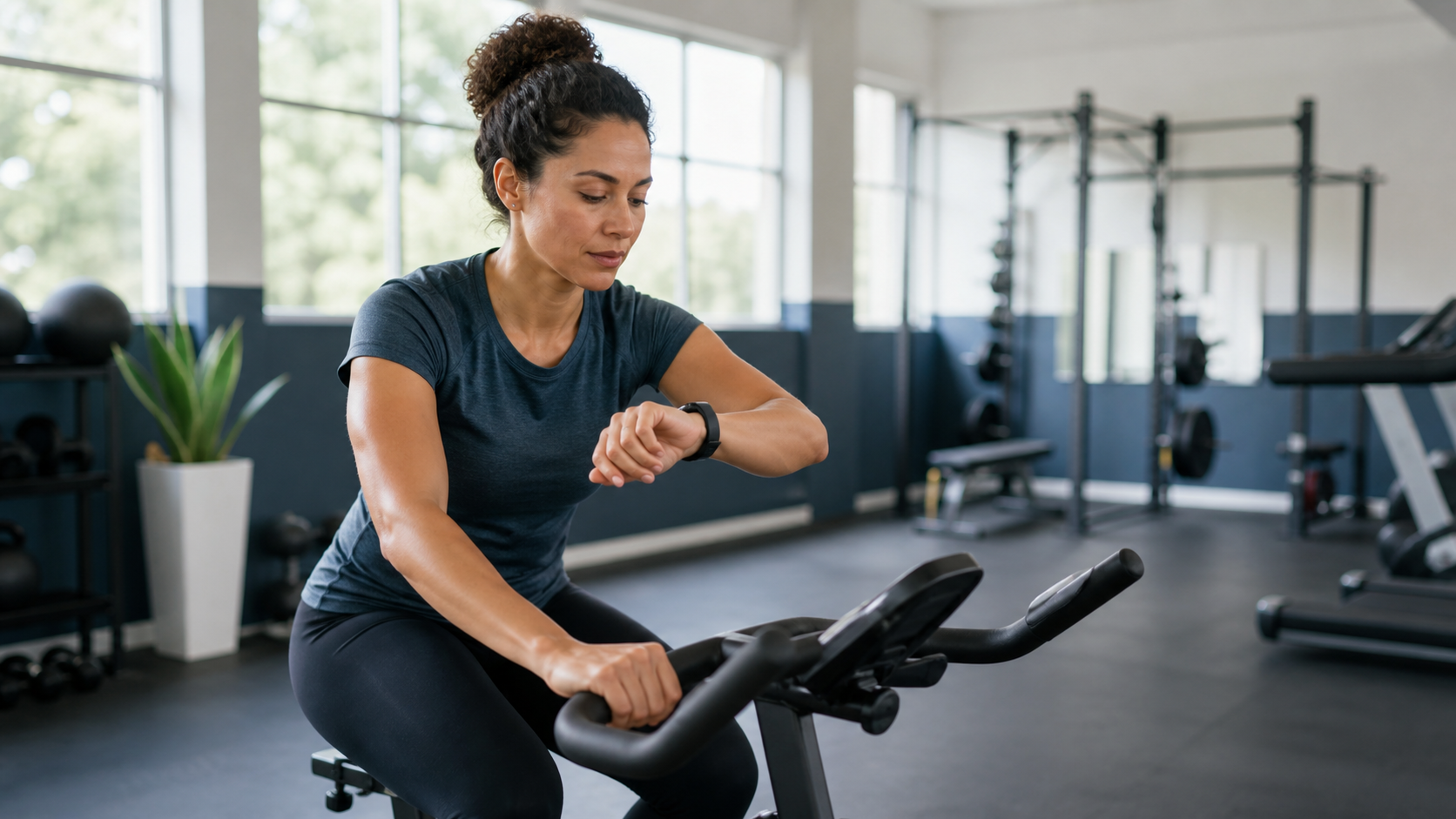

Zone 2 cardio has become the internet’s favorite way to make “go for an easy walk” sound like a laboratory protocol. Behind the hype is a useful idea: spend time at a sustainable aerobic effort that challenges you without leaving you gasping, bargaining, or reconsidering every life choice.
The tricky part is that “Zone 2” does not mean exactly the same thing in every heart-rate system. This guide explains the definitions, shows three practical ways to estimate your effort, and gives beginners a four-week plan that works with walking, cycling, rowing, or an elliptical.
Quick answer: For most beginners, Zone 2 feels easy to moderate. You can speak in full sentences, your breathing is deeper but controlled, and you could continue for a while. Start with 20-minute sessions twice per week and progress toward three 30- to 45-minute sessions.
What is Zone 2 cardio?
Exercise scientists often divide intensity into physiological domains using lactate or ventilatory thresholds. A 2025 expert viewpoint described Zone 2 as work immediately below the first lactate or ventilatory threshold. Consumer watches commonly divide heart rate into five zones and label roughly 60% to 70% of maximum heart rate as Zone 2. Those systems overlap, but they are not identical.
This explains why two apps can look at the same workout and disagree. Your watch is not necessarily broken; it may be using a different map. For a beginner without laboratory testing, effort and breathing are often more useful than obsessing over a single heartbeat.
Potential benefits of steady aerobic training
- Builds aerobic capacity: Regular steady cardio helps your heart, lungs, circulation, and working muscles handle sustained activity.
- Supports weekly activity goals: Easy-to-moderate sessions can help adults accumulate the recommended 150 to 300 minutes of moderate aerobic activity.
- Creates less fatigue than hard intervals: You can often recover quickly enough to combine it with strength training.
- Improves pacing awareness: You learn what sustainable effort feels like without depending completely on a device.
- Offers flexible exercise choices: Walking, cycling, rowing, swimming, and elliptical work can all qualify.
Zone 2 is not uniquely magical. Higher and lower intensities can produce some of the same adaptations, and recent scientific discussion cautions against claiming that Zone 2 is automatically superior for everyone. It is best viewed as one useful part of a balanced program.
Three ways to find your Zone 2 effort
1. The talk test
This is the simplest method. You should be able to speak in complete sentences, though singing a flawless chorus may feel less appealing. If you can say only a few words before breathing, reduce the pace or resistance. If the effort feels almost motionless, increase it slightly.
2. Rating of perceived exertion
On a 1-to-10 scale, aim around 3 to 4: clearly exercising, but in control. Your legs may feel warm and your breathing should be noticeable, not desperate. Perceived effort changes with heat, sleep, caffeine, stress, and fatigue, which is useful information rather than a flaw.
3. Estimated heart-rate range
A basic five-zone estimate uses 60% to 70% of maximum heart rate. A common maximum-heart-rate shortcut is 220 minus age, but individual error can be substantial. For a 40-year-old, the calculation estimates a maximum of 180 beats per minute and a Zone 2 range around 108 to 126. Treat that as a starting experiment, not a diagnosis.
| Age | Estimated max | Approx. 60%–70% |
|---|---|---|
| 20 | 200 bpm | 120–140 bpm |
| 30 | 190 bpm | 114–133 bpm |
| 40 | 180 bpm | 108–126 bpm |
| 50 | 170 bpm | 102–119 bpm |
| 60 | 160 bpm | 96–112 bpm |
Medications, especially some heart and blood-pressure medicines, can alter heart-rate response. In that situation, use guidance from your clinician and favor the talk test or a professionally prescribed range.
The 4-week beginner Zone 2 plan
| Week | Sessions | Zone 2 time | Plan |
|---|---|---|---|
| 1 | 2 | 15–20 min | Easy continuous effort |
| 2 | 2–3 | 20–25 min | Stay conversational |
| 3 | 3 | 25–35 min | Add time to one session |
| 4 | 3 | 30–45 min | Create a sustainable weekly schedule |
Week 1: Find the feeling
Complete two sessions. Warm up easily for five minutes, spend 15 to 20 minutes at a conversational pace, and cool down for five. Check your breathing more often than your watch. The goal is calibration, not exhaustion.
Week 2: Repeat before progressing
Perform two or three sessions of 20 to 25 minutes in the target effort. If your heart rate drifts upward while the speed stays constant, slow down slightly. Heat, dehydration, and fatigue can all produce drift.
Week 3: Extend one session
Complete three sessions. Keep two near 25 minutes and extend one toward 35 minutes. You should finish feeling as if you could do a little more. That restraint is what lets you train again instead of needing a ceremonial recovery day.
Week 4: Establish your routine
Schedule three 30- to 45-minute sessions around your strength workouts. If you follow our 3-day beginner gym routine, place easy cardio after lifting or on separate days according to your energy and schedule.
Best Zone 2 exercises for beginners
Incline or outdoor walking is accessible and easy to adjust. Cycling reduces impact and makes resistance changes simple. Elliptical training offers a full-body rhythm without running impact. Rowing works well after technique is learned, although beginners often row too hard. Swimming is effective but makes conversation and heart-rate tracking less practical.
Choose the mode that lets you stay steady and comfortable. The best machine is not the one with the most impressive console; it is the one you will use next week.
How Zone 2 fits with strength training
Two to three steady sessions usually pair well with a beginner lifting plan. Keep cardio genuinely moderate so it does not sabotage technique or recovery. If leg strength is the priority, lift before cardio in the same session. If aerobic development is the priority, separate demanding sessions when possible.
Our guide to how many days beginners should train can help you build a realistic weekly schedule.
Common mistakes
- Turning every session into Zone 3: Slow down when conversation becomes difficult.
- Treating watch zones as laboratory measurements: Algorithms are estimates.
- Adding duration too quickly: Increase one session at a time.
- Ignoring strength and higher-intensity work forever: Zone 2 is a foundation, not the entire house.
- Chasing calorie burn: Train for consistent fitness and manage nutrition separately.
Frequently asked questions
How long should a Zone 2 workout be?
Beginners can benefit from 20 to 30 minutes. Longer sessions may be appropriate after fitness and tolerance improve. Weekly consistency matters more than a mythical minimum duration.
Can walking count as Zone 2?
Yes. Brisk walking or incline walking can create the appropriate effort, depending on your fitness. A trained runner may need a steeper incline or faster mode.
Is Zone 2 best for fat loss?
Your body uses a higher proportion of fat at some lower intensities, but long-term fat loss depends mainly on sustained energy balance, activity, diet, sleep, and adherence. “Fat-burning zone” does not mean automatic body-fat loss.
The bottom line
Zone 2 cardio is valuable because it is sustainable, not because it unlocks a secret human setting. Use the talk test, begin with manageable sessions, and combine steady aerobic work with strength training and occasional harder efforts when appropriate.
Sources: expert viewpoint on Zone 2 training; Physical Activity Guidelines for Americans.
Keep learning: four-week Zone 2 cardio plan and walking-pad workout plan offer practical next steps on this topic.
Leave a Reply