
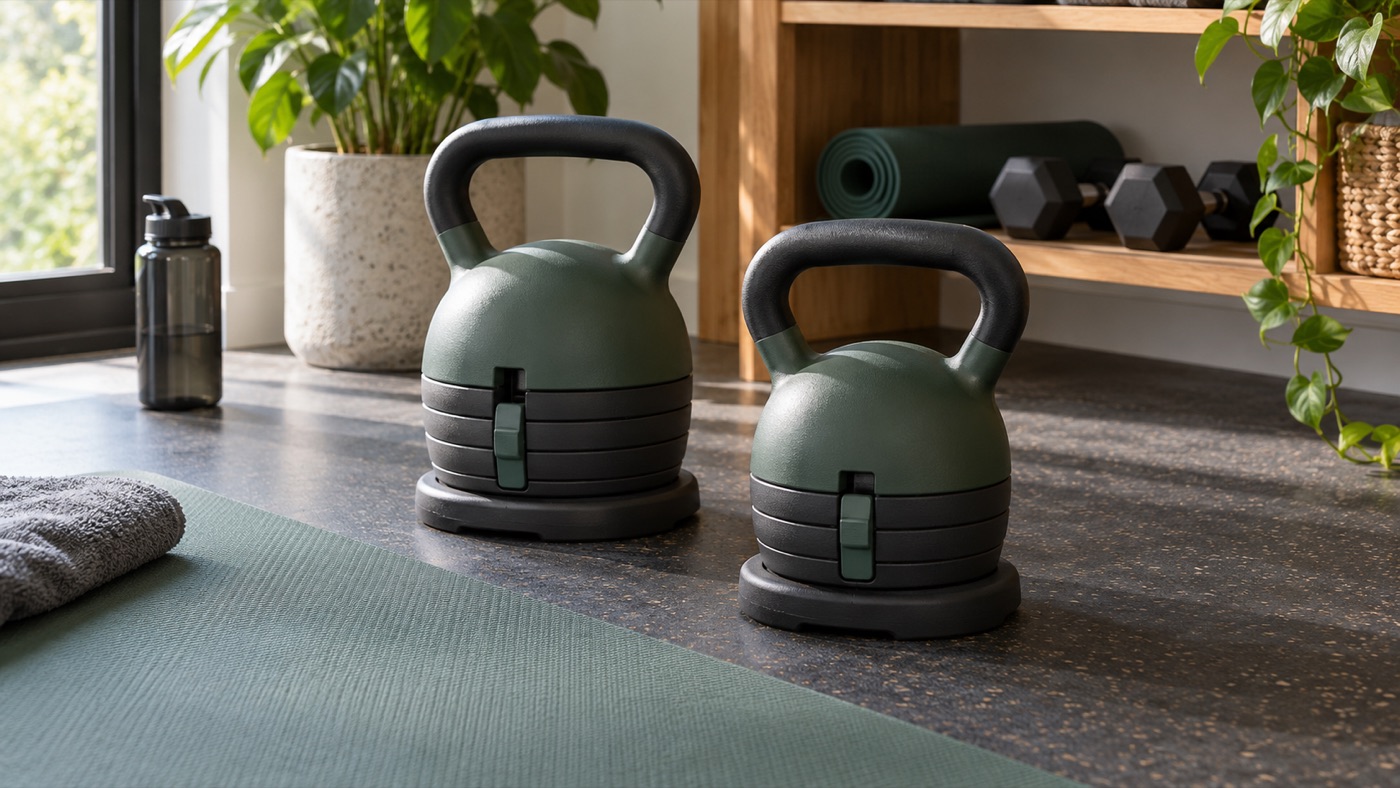
The best adjustable kettlebell for a small home gym is the one with a usable starting weight, sensible weight increments, and an adjustment system that fits your workout. Not the heaviest one. Not the shiniest one. And definitely not the one you buy because a person on the internet made forty complicated movements look suspiciously effortless.
Adjustable kettlebells appeal to anyone trying to build strength without turning a spare bedroom into a warehouse. One implement offers several loads, leaving more room for a mat, a chair, and the rest of your actual life. The broader theme is timely: ACSM’s 2026 trends forecast includes traditional strength training and functional fitness. That is industry context, not proof of a specific keyword’s search-growth rate.
This guide compares REP Fitness, BowFlex SelectTech 840, and a lighter Bells of Steel option. We cover weight ranges, buying costs, adjustment trade-offs, a space-saving infographic, beginner-friendly planning, and the questions that stop an impressive purchase becoming a very expensive doorstop.
Quick picks by buying priority
If quick changes between several moderate loads are your priority, investigate REP’s push-and-twist options. If a particularly light minimum weight matters, look at the BowFlex 840’s published 8-pound starting point. If you want a lighter adjustable range with a competition-style shape, investigate Bells of Steel’s 6–12 kg model and its plate-adjustment instructions.
Those recommendations are shortlisting judgments based on design, not scores from a secret testing laboratory. The right choice depends on what you can comfortably lift today and what movements you plan to practice. A bell you can deadlift easily might still be too heavy for an overhead press. One person’s beginner load is another person’s warm-up, so shopping by identity labels is unreliable.
Adjustable kettlebell comparison table
| Option | Published load range | Price information | Adjustment approach | Best reason to shortlist | Main limitation |
|---|---|---|---|---|---|
| REP 8–16 kg | 8, 10, 12, 14, 16 kg | $149.99 displayed for this variant | Push down and twist | Five settings with convenient changes | 8 kg minimum may be too heavy for some movements |
| REP 16–24 kg | 16, 18, 20, 22, 24 kg | Variant-specific; confirm selected checkout price | Push down and twist | Heavier progression range | Not a general-purpose beginner starting range |
| BowFlex SelectTech 840 | 8–40 lb; six settings | Current price not reliably exposed; check official seller | Weight-selection dial | Lighter published minimum | Maximum and discrete jumps may limit long-term progression |
| Bells of Steel 6–12 kg | 6–12 kg | Current price not reliably exposed; verify configuration | Internal plate adjustment; follow model instructions | Lighter competition-style option | Lower ceiling and more involved changes than a selector dial |
Official references: REP adjustable kettlebell, BowFlex SelectTech 840, and Bells of Steel 6–12 kg. Compare exact variants, not a brand’s lowest advertised starting price. Kilograms and pounds are different units; 8 kg is about 17.6 lb, not 8 lb.
Adjustable versus fixed: what are you really buying?
A fixed kettlebell gives you one load with no selection procedure. An adjustable kettlebell offers several loads in one footprint, but adds a mechanism you must operate correctly. Neither design is automatically better. The adjustable option is especially attractive when storage is tight or when several exercises require different manageable weights.
Imagine a small apartment routine with a controlled deadlift, a supported row, and a squat variation. You might prefer different resistance for each movement. Several fixed bells require more space and a larger combined purchase. One adjustable bell can simplify storage, provided its available settings cover your needs and its adjustment process does not turn every rest period into equipment maintenance.
Fixed bells still make sense for people who share equipment, move rapidly between loads, or prefer mechanically simple tools. A pair of adjustable bells can be useful later, but buying two immediately is not compulsory. Start with the movements you can perform and a program you can repeat. Equipment variety should follow a training need, not create one.
REP Fitness: convenient changes across a defined range
REP offers separate ranges rather than one bell that spans every possible weight. Its 8–16 kg and 16–24 kg models each provide five settings, while the pound-based option covers 20–40 lb. The published push-and-twist adjustment makes these worth investigating for routines where you change load between exercises.
That convenience comes with an important shopping rule: buy the correct range. The heavier option is not a superior beginner purchase merely because it contains more mass. For someone practicing controlled upper-body work, the minimum can be the deciding specification. A discount on an unusably heavy tool is not a bargain; it is storage with handles.
Pros: straightforward published adjustment, several clear settings, and a consistent shape across loads. Cons: the increments and minimum may not suit every exercise. REP states that the adjustable models are not intended to be dropped or slammed. That limitation matters when considering training style, flooring, and whether other people in the household understand how the equipment should be handled.
BowFlex SelectTech 840: a lighter minimum is the headline
BowFlex publishes an 8–40 lb range with six settings selected by a dial. The lower starting point is the feature that deserves attention here. It creates a different shortlisting scenario from the kilogram models above, especially for someone who wants a lighter option for learning a controlled movement.
The trade-off is that six settings do not mean six equally spaced steps, and a 40-pound ceiling might eventually become limiting for some exercises. Examine the exact settings in the current manual rather than assuming the range is continuous. A dial changes how you select a load; it does not guarantee the ideal increment for your next session.
Pros: a low published minimum and a dial-based ownership approach. Cons: discrete settings, a finite maximum, and model-specific handling requirements. The official page also mentions optional JRNY workout access, but verify current membership terms separately. The bell’s usefulness should not depend on assuming an app trial is a permanent included benefit.
Bells of Steel 6–12 kg: evaluate the lighter plate-based approach
Bells of Steel’s lighter adjustable model occupies a useful middle ground: more modest loads within a competition-style design. Check the current product page and instructions for the included plates, exact increments, and adjustment tools. Plate-based systems demand a different rhythm from quick selectors, so consider when you would change the weight during your session.
If you keep one load for several sets, a more involved adjustment procedure may be no problem. If your imagined workout alternates weight every thirty seconds, it could become annoying. This is a planning question more than a brand loyalty question. The best adjustment system is the one that works when you are slightly tired and would rather not solve a puzzle.
Pros: a lighter published range and a form factor worth considering for learning. Cons: the 12 kg ceiling may eventually require another purchase, and the change procedure needs learning. Confirm whether you are buying the complete kettlebell or an expansion/accessory listing. Similar-looking product names can describe very different contents.
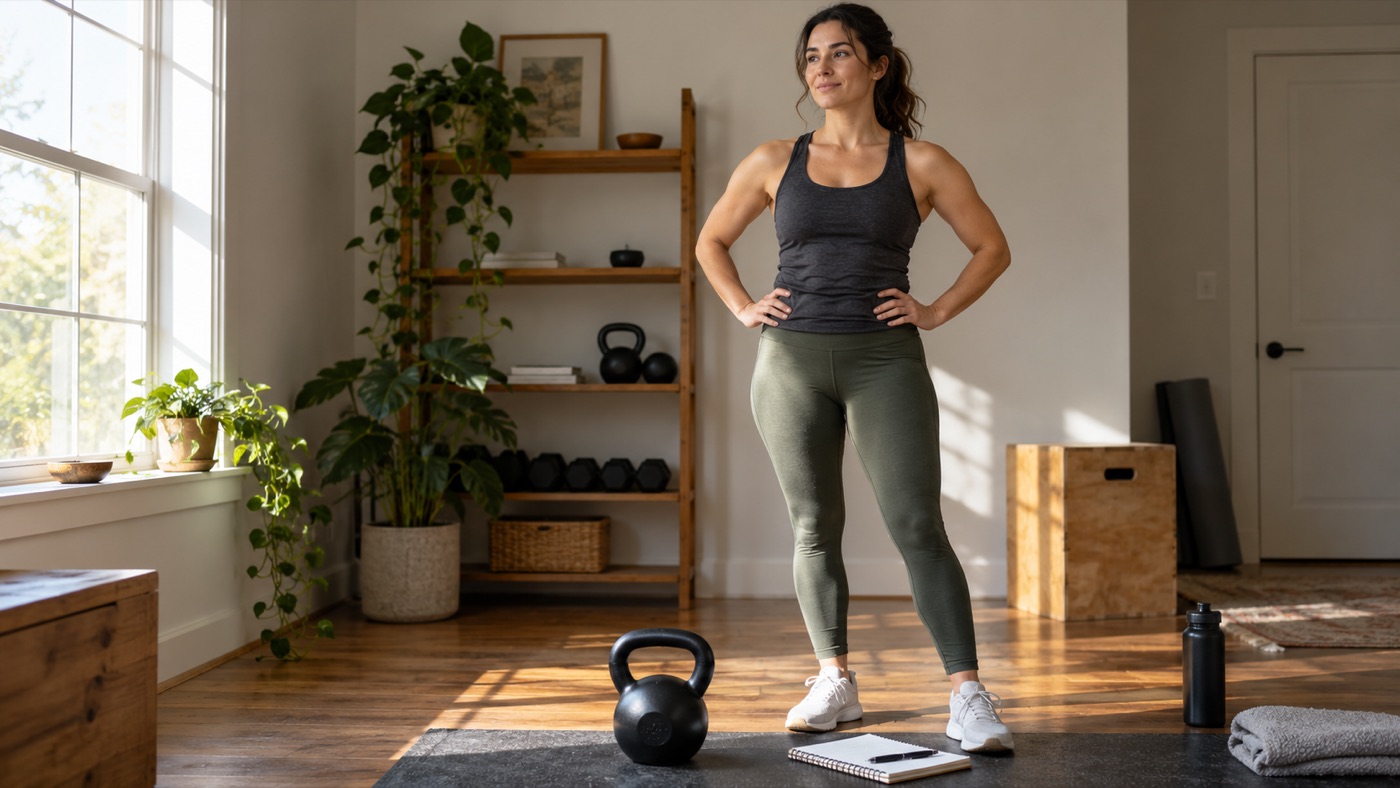
Buying infographic: four questions before checkout
The illustration prioritizes usable loads over headline maximums. Start by writing down two or three exercises you genuinely intend to perform. Then consider the lightest load you can control for the most demanding of those movements. If you do not yet know, a supervised gym session or coached introduction can be a smarter first purchase than guessing from an equipment photograph.
How to choose a starting weight without guessing from body size
Your height, body weight, and enthusiasm do not provide a reliable universal kettlebell prescription. Experience, movement, coordination, and individual limitations all matter. Choose resistance that lets you perform the planned motion with control and leave a comfortable margin rather than struggling through the first repetition. Begin with simpler movements before chasing technical lifts.
A heavy minimum can force an awkward compromise: your lower-body exercise feels comfortable, but your upper-body work is unmanageable. In that case, a lighter fixed bell or another resistance tool might be more useful than stretching the meaning of “beginner friendly.” Our starting-weight guide offers a practical way to think about controlled resistance.
Do not use an overhead exercise as a test of courage. If a movement causes pain, feels unstable, or exceeds your current technique, stop and seek qualified coaching or an appropriate alternative. A comparison article cannot assess your individual readiness. It can help you ask better buying questions, which is considerably more valuable than pretending one load suits everyone.
Weight increments: the overlooked specification
Minimum and maximum loads tell only part of the story. The steps between them determine how easily you can progress. A jump that feels manageable for a lower-body movement may be large for an overhead press. This does not automatically disqualify a bell, but it changes how you organize progression and which exercises suit it.
You can sometimes progress with an additional controlled repetition, improved range within your ability, or more consistent practice before adding resistance. You should not compensate for a large jump by abandoning technique. Read our progressive overload for beginners guide and choose one variable at a time. Progress is not an obligation to increase weight every Tuesday.
Space and flooring: measure the workout, not just the bell
One compact implement can still require a clear movement area. Measure where you will stand, place the bell down, and move safely. Consider ceiling height, nearby furniture, pets, and people passing through the room. A storage footprint is not a safe-training footprint, especially when movements involve a swinging implement.
A suitable surface should be stable and consistent with the manufacturer’s instructions. A mat may protect a floor from ordinary contact but does not turn an adjustable kettlebell into drop-safe equipment. Keep the bell away from edges and avoid unstable improvised platforms. Apartment neighbors will also appreciate training that does not sound like a small construction crew has arrived upstairs.
Plan where any base, removed plates, or tools will live. Loose components underfoot defeat the point of a tidy home gym. Store the equipment so children cannot casually operate it, and inspect it before each session. If a selector, fastener, or housing appears damaged, stop using the bell and consult the manufacturer rather than testing whether optimism can hold weight plates together.
A realistic cost comparison
Compare the delivered cost of the exact loads you need. An adjustable bell is not automatically cheaper than one fixed bell, because one fixed bell does less. It may compare favorably with several separate weights, but the answer depends on the actual products, shipping, and whether you use the available settings.
For illustration only, a $150 purchase used twice weekly for a year works out to roughly $1.44 per session before other costs. If it is used ten times and forgotten, the same purchase costs $15 per session. Those are simple arithmetic examples, not predicted product prices or guaranteed savings. Consistent use is the variable that most equipment advertisements politely leave out.
Also compare a basic gym membership, a few coached sessions, or inexpensive bands. If your main barrier is uncertainty about technique, equipment alone may not solve it. A small coaching budget can make your eventual purchase more informed. Our resistance-band beginner workout is another compact option if your space or starting budget is very limited.
A simple first-month ownership plan
Week one: learn the equipment. Read the manual, practice adjustments with the bell safely grounded, and confirm that everything locks or fastens correctly. Identify a safe place to set it down. Practice simple controlled movements with appropriate guidance rather than immediately copying a high-speed social-media sequence.
Week two: repeat a small routine. Choose a manageable selection of movements you understand. Record the settings used and how controlled the session felt. Keep the process boring enough to repeat. Boring is underrated when the alternative is remembering six new techniques and losing the adjustment tool under the sofa.
Week three: improve consistency. Look for smoother setup, stable positioning, and a routine you can fit into an ordinary day. Do not change every variable simultaneously. If the bell is too heavy for one movement, substitute an appropriate alternative rather than deciding your body should negotiate with the purchase receipt.
Week four: review before expanding. Ask whether you need another weight range, more coaching, or simply more practice. Your workout log will answer better than a sale banner. A useful home gym grows around repeated needs, not hypothetical future versions of yourself who train twice a day and never misplace anything.
Pros and cons of adjustable kettlebells as a category
The biggest advantages are compact storage, several loads in one tool, and the ability to adapt resistance without collecting a shelf of equipment. They can be appealing for small homes and people who enjoy training independently. A good fit can reduce setup friction and help an ordinary routine feel easier to repeat.
The main disadvantages are model-specific mechanisms, weight-range compromises, and handling restrictions. Shared workouts may need duplicate equipment, and some owners will eventually outgrow the maximum or want finer increments. Those are ordinary design trade-offs, not reasons to dismiss the entire category. Match them against the routine you will actually perform.
Frequently asked questions
Are adjustable kettlebells suitable for beginners?
They can be, if the minimum load is appropriate and the mechanism is used correctly. A beginner label on a shopping page does not replace individual assessment or instruction. Simple controlled exercises and qualified guidance are sensible starting points.
Can I swing every adjustable kettlebell?
Check the manufacturer’s intended uses and locking instructions for your exact model. Do not assume every design supports every movement. Learn the technique first and stop if the mechanism is damaged or the load does not feel securely retained.
Should I buy one or two?
One can support a useful range of single-implement exercises. Two make sense when your established program calls for them and you can manage both appropriately. You do not need a pair to justify beginning.
Is the most expensive model the best?
Not necessarily. Price can reflect materials, adjustment design, brand positioning, or included components. Compare usable range, handling requirements, support, and delivered cost. A premium feature you never use does not improve your routine.
Bottom line: choose a bell your routine can grow around
The best adjustable kettlebell for a small home gym balances a manageable minimum, useful increments, and a comfortable ownership process. Shortlist by those priorities, confirm the exact variant and current price, and leave room in your budget for learning. A compact tool plus a repeatable plan beats an impressive collection that mainly gathers dust.
Leave a Reply