
Progressive overload for beginners means gradually asking your muscles to do more as your ability improves. That might mean one extra repetition, a slightly heavier dumbbell, or another controlled set. It does not mean adding weight every workout, collecting soreness like loyalty points, or turning a perfectly good squat into an emergency dance move.
This guide explains how to progress without guessing. You will learn a simple repetition-based method, see a realistic training log, and discover what to change when progress slows. The examples are starting templates for generally healthy adults, not personalized exercise prescriptions. Choose movements you can perform comfortably and ask a qualified trainer for technique help when needed.
What is progressive overload?
Your training should remain appropriately challenging as you become stronger. If you repeat the same easy session forever, it may eventually provide less stimulus for further improvement. Progressive overload addresses that by increasing the demands gradually, while keeping exercise technique and recovery in the picture.
Imagine carrying two grocery bags that once felt heavy. After several weeks, they feel ordinary. In training, you can respond by lifting a little more, completing additional repetitions, or doing more total work. The increase should match your current capacity. Your muscles do not know that an influencer promised weekly personal records.
The ACSM 2026 resistance-training update emphasizes regular participation and individualized programming. It also reports that routinely training to muscular failure is not necessary for the average healthy adult. Those findings support a practical approach: establish a repeatable routine, then adjust the challenge thoughtfully.
Start with a reliable baseline
Before increasing anything, decide what a good repetition looks like. Use a comfortable range of motion, a stable position, and a controlled return. Record the exercise, weight, repetitions, and sets. If you change the seat height, grip, and movement depth every visit, comparing results becomes surprisingly difficult.
Choose a starting weight that lets you complete your planned repetitions while feeling that a few more good repetitions would still be possible. This estimate takes practice. Beginners should treat it as a rough guide rather than a precise scientific measurement. Our starting-weight guide explains the first-session decision in more detail.
Keep the same main exercises for several weeks unless a movement is uncomfortable or unsuitable. Repetition gives you a chance to learn the setup. Changing everything because Tuesday felt ordinary makes progress harder to measure. Ordinary sessions are often where useful training happens.

Five ways to make an exercise more challenging
| Change | Simple example | Main caution |
|---|---|---|
| Add repetitions | Move from eight to nine controlled reps | Stay within your planned range |
| Add resistance | Use the next small dumbbell increment | Expect repetitions to fall initially |
| Add a set | Move from two working sets to three | Account for extra fatigue and time |
| Improve movement quality | Use a more consistent comfortable range | Do not force painful positions |
| Choose a harder variation | Lower a push-up support slightly | Change one variable at a time |
These options are not interchangeable in every situation. Better technique is valuable even when the weight stays unchanged, but it does not automatically mean you increased mechanical load. Shortening rest can make a session feel harder while reducing the quality of later sets. More breathlessness is not always better strength training.
For a beginner, repetitions and small resistance increases are usually the easiest variables to follow. Save complicated combinations for when you have a reason to use them. A notebook can handle the job; a spreadsheet with twelve color-coded tabs is optional entertainment.
Use double progression: reps first, then weight
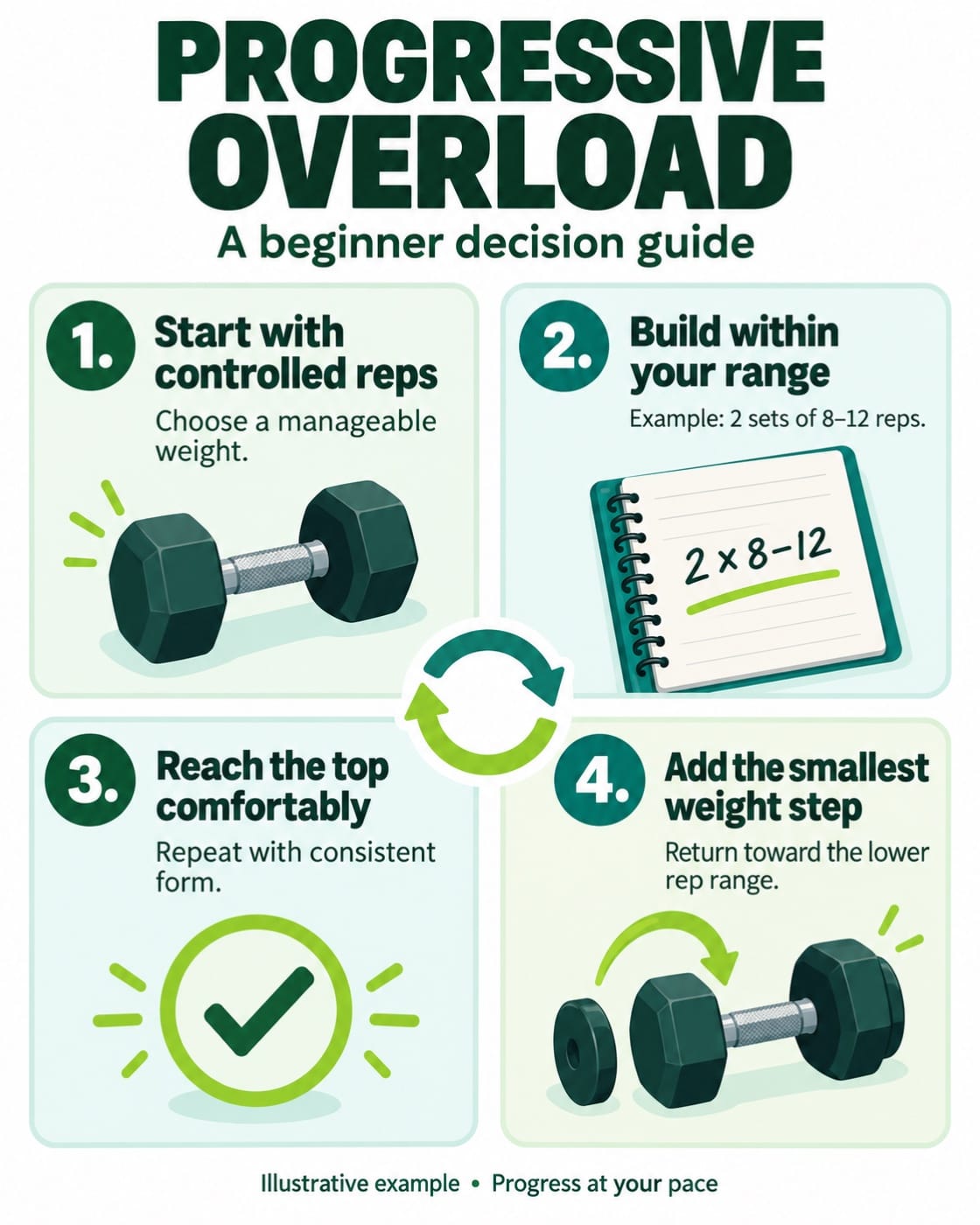
Double progression uses a repetition range before increasing resistance. For example, choose two working sets of eight to twelve repetitions for a machine row. Begin with a load you can control for at least eight repetitions per set. Over future sessions, gradually work toward twelve on both sets.
When both sets reach twelve with consistent technique and manageable effort, repeat that performance to check it was not an unusually good day. Then try the smallest available increase. Your repetitions may return toward eight. You have begun another cycle rather than gone backward.
The exact range and number of sessions are examples, not universal rules. Some exercises suit different ranges. A large machine increment may be too much, particularly for smaller muscle groups. If you cannot complete the lower end cleanly, return to the previous resistance and reconsider the size of the jump.
A realistic progression log
Here is an illustrative machine-row log. The weights are invented examples, not recommendations for your body. Notice that improvement is uneven. Repeating a performance is useful information, and a slightly lower second set is completely compatible with a productive workout.
| Session | Resistance | Set one / set two | Next decision |
|---|---|---|---|
| 1 | 30 lb | 8 / 8 | Practice the setup |
| 2 | 30 lb | 9 / 8 | Keep the same load |
| 3 | 30 lb | 10 / 9 | Add reps when comfortable |
| 4 | 30 lb | 10 / 9 | Repeat without forcing |
| 5 | 30 lb | 12 / 12 | Confirm good technique |
| 6 | 30 lb | 12 / 12 | Consider a small increase |
| 7 | Next suitable increment | Near the lower range | Begin building again |
Also record brief context: poor sleep, a different machine, or a shorter rest period. Two machines labeled with identical weights may feel different because their mechanics differ. Compare performance on the same equipment whenever practical. Your log should explain the session, not judge your personality.
Fit progression into a weekly routine
Start with a schedule you can repeat. Two nonconsecutive strength sessions can be a practical entry point, with exercises covering the major muscle groups. The CDC adult activity guidance recommends muscle-strengthening activity on at least two days weekly alongside aerobic activity. That population guideline is a useful foundation, not a complete individualized program.
For each workout, choose familiar lower-body, pushing, and pulling exercises, plus suitable core work. Our three-day beginner gym plan offers a structured alternative if three visits fit your schedule. Apply the progression method within a routine instead of adding random exercises whenever motivation spikes.
Warm up before your working sets, including lighter practice when useful. Rest long enough to repeat the movement with control. Around one to three minutes may be a practical starting range, with more time if needed. Rushing to beat a timer can turn a strength decision into a breathing contest.
How much effort is enough?
A working set should become challenging toward the end without requiring you to abandon the movement you intended to perform. If twelve repetitions feel effortless, the resistance may eventually need adjustment. If repetition three requires twisting, bouncing, or assistance, the challenge probably arrived too early.
“Repetitions in reserve” describes how many additional clean repetitions you think you could complete. Leaving roughly two or three is one conservative starting cue, but new lifters often estimate inaccurately. Combine that feeling with observable technique and consistent performance. Do not test failure just to prove your estimate.
Stop for sharp pain, dizziness, or unusual symptoms. Normal muscular effort and a movement that feels wrong deserve different responses. Existing injuries, medical conditions, or uncertainty about exercise suitability are reasons to get individual guidance before increasing the challenge.
What to do when progress stalls
One flat session is not a plateau. First compare several similar workouts. Check whether your exercise setup, rest, and repetition standard stayed consistent. Then look at sleep, missed meals, stress, and how much other training you added. Your body does not keep separate recovery accounts for lifting, running, and moving furniture.
If performance has declined across multiple sessions, consider an easier week with less total work or lighter resistance. There is no mandatory calendar for this. Return gradually and assess how you feel. Persistent pain, unusual fatigue, or unexplained weakness deserves professional attention rather than another motivational quote.
If you feel well but a weight increment is too large, stay at the current load longer, use smaller increments if available, or select equipment with finer adjustments. Avoid shortening your range simply to claim the heavier weight. The number increased, but the exercise changed.
Common mistakes that hide real improvement
Changing several variables together: adding weight, sets, and training days simultaneously makes it difficult to identify what helped or caused excess fatigue. Choose one main change and observe the result.
Using soreness as your score: soreness varies and is not a requirement for progress. A session can be productive without making stairs feel like a personal attack. Track performance and consistency instead.
Ignoring smaller wins: steadier balance, a repeatable setup, and an extra controlled repetition matter. These changes may make future resistance increases possible even when today’s log looks similar.
Progressing every exercise equally: your leg press and shoulder exercise may improve at different rates. Treat each movement separately. There is no rule that every line in your notebook must receive a promotion on Friday.
Frequently asked questions
Should beginners increase weight every week?
No. Increase resistance when your performance supports it. Some weeks you will add repetitions, while other weeks you will repeat the same work. A calendar reminder cannot assess technique or recovery.
Can progressive overload work with resistance bands?
Yes. Track the band, setup, repetitions, and range carefully because tension changes with stretch. Our beginner resistance-band workout explains practical setup and progression choices.
Do I need to test my maximum lift?
No. A beginner can select manageable working weights without attempting a one-repetition maximum. Learning comfortable technique and recording ordinary sessions gives you useful information with less complexity.
How long until I notice progress?
It varies. Early changes may include better coordination and more confidence before visible changes appear. Review several weeks of training rather than demanding proof after every visit. Improvement is a trend, not a deadline.
A four-week review
Use the first week to establish your baseline. Learn the seat settings, choose comfortable weights, and record what you completed. During the second week, aim to repeat those conditions. If an extra repetition appears naturally, record it; if not, keep practicing. During the third week, look for a consistent pattern rather than one impressive set. In week four, review the entire log and decide which exercises are ready for a small adjustment.
Suppose your chest press improved but your row stayed unchanged. You can increase the press when appropriate and continue practicing the row. You do not need to redesign the whole routine. If everything feels harder, investigate recovery before adding more work. If everything feels easy, your initial loads may have been conservative, which is useful information rather than a mistake.
Keep a short note about confidence too. Knowing how to adjust a machine without hesitation is meaningful progress, especially early on. A successful month might include better attendance, more consistent repetitions, and just one small weight increase. Those outcomes provide a stronger foundation than a dramatic session followed by ten days away.
For home workouts, take a similarly practical approach. Record the height of a push-up support or the band setup so you can reproduce it. For gym workouts, note the machine model when you switch locations. Small details make your comparisons fairer. The purpose of tracking is to simplify decisions, so stop recording anything that you never use. A clear five-line entry beats an elaborate system you abandon after three workouts. Keep it brief, useful, and easy to repeat next time.
Your next workout
Choose one familiar exercise, write down a repetition range, and record two controlled working sets. At your next session, use that information to decide whether to repeat, add a repetition, or adjust resistance. Keep the choice small enough that technique remains recognizable.
Progressive overload works best as an ongoing conversation with your training log. Show up, practice, notice what changed, and adjust. You do not need a dramatic workout every time. You need enough useful sessions to give those small improvements somewhere to accumulate over the months.
Leave a Reply