

You finish a set, put the dumbbells down, and face the gym’s least glamorous question: what now? Start again immediately? Wait until your breathing settles? Accidentally watch seven videos and call it recovery?
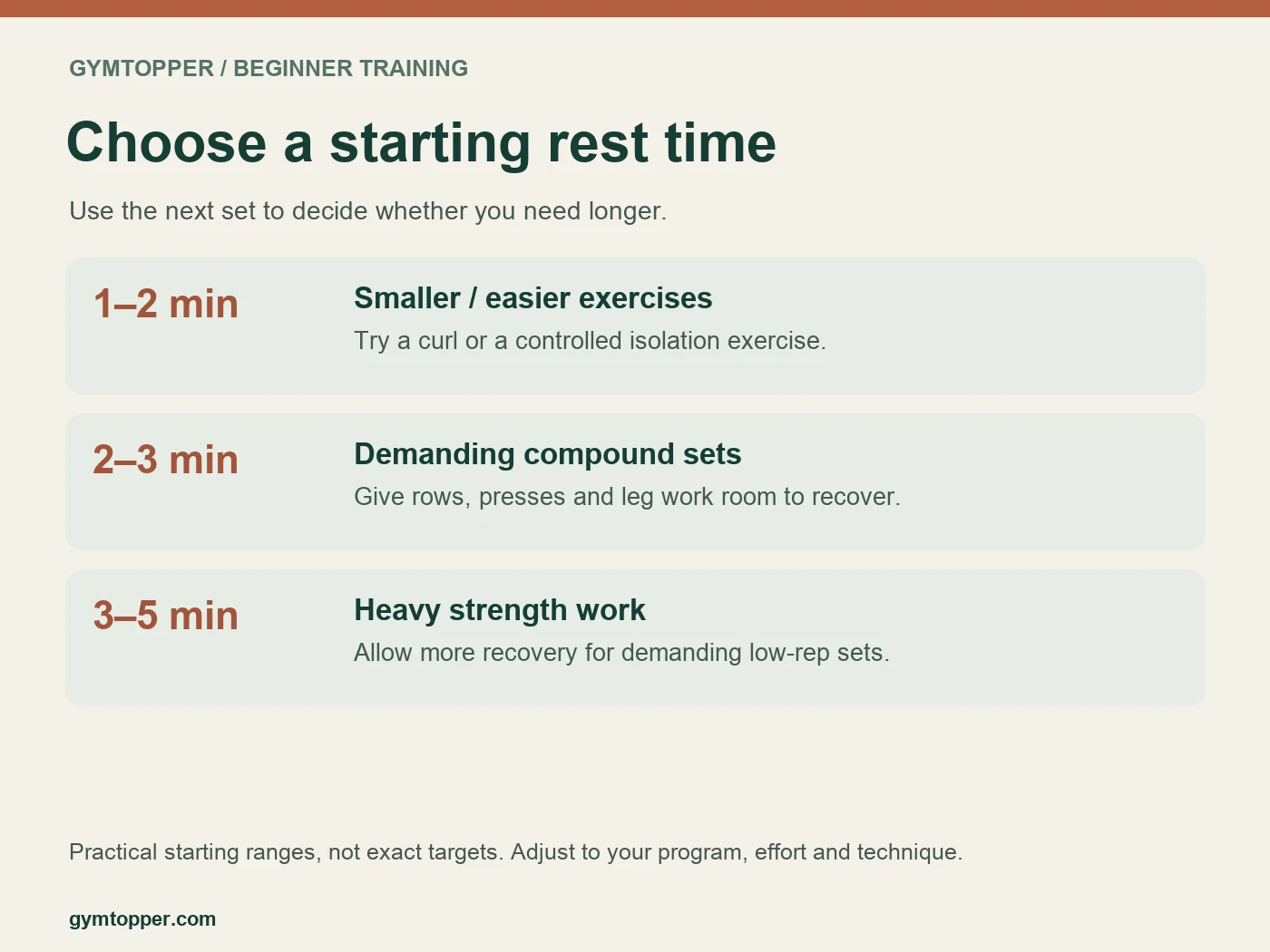
How long should you rest between sets? For a beginner doing general strength training, start with about 1–2 minutes after easier exercises and 2–3 minutes after demanding compound exercises. Heavy strength work may call for 3–5 minutes. Treat these as starting ranges: your next set should be controlled, purposeful, and appropriate for the workout.
This guide explains how to choose a useful rest interval, adjust it when repetitions fall, and fit it into a realistic session. You do not need an expensive wearable. A timer and a few honest training notes will do.
Rest between sets: a practical starting chart
Use the table to choose your first timer setting. These are practical programming suggestions, not precise biological deadlines or a prescription for every person. A coach’s individualized program takes priority.
| Workout situation | Start with | What to check |
|---|---|---|
| Moderate compound lifts | 2–3 minutes | Breathing, setup and repeatable repetitions |
| Smaller isolation exercises | 1–2 minutes | Target-muscle fatigue and controlled movement |
| Heavy strength sets | 3–5 minutes | Readiness for demanding low-repetition work |
| Light technique practice | About 1 minute, then reassess | Attention, comfortable breathing and execution |
| Conditioning circuits | Follow the planned interval | Whether fatigue is undermining technique |
A squat, row or chest press involves several joints and can feel very different from a curl. Even within one exercise, a comfortable first set and a demanding final set may need different recovery. The table gives you somewhere sensible to begin, rather than another rule to feel guilty about.
Why rest matters more than looking busy
A rest interval lets some of the fatigue from your previous effort subside before you repeat it. The practical question is whether you can deliver the next set well. If you rush, the session can become limited by breathlessness or tired grip before the muscle you intended to train gets useful work.
Imagine planning three sets of eight on a chest-press machine. Set one feels controlled. After a hurried break, set two ends at five shaky repetitions. That does not automatically mean you chose a terrible exercise. Your break, load, effort level or a combination of these may need attention.
Rest also gives you time to check the seat setting, write down the result and think about one technique cue. Those actions are part of training. Standing still for two minutes is allowed; the gym does not charge a productivity penalty.
What the research says—and what it cannot promise
A 2024 systematic review and meta-analysis by Singer and colleagues combined nine studies. It found muscle growth across different rest intervals, with a possible small advantage for rests longer than 60 seconds. Results were uncertain and varied between studies. It did not establish a meaningful additional growth advantage above roughly 90 seconds.
That finding does not make 90 seconds a universal optimum. The studies used different exercises and mostly short interventions, and evidence for older adults and experienced lifters was limited. Choosing extra recovery to preserve performance can still be reasonable.
In one 2016 trial involving 21 trained young men, three-minute rests produced greater squat and bench-press strength gains and greater anterior-thigh growth than one-minute rests over eight weeks. It was a small trial, not proof that every beginner needs three minutes after every exercise.
The useful takeaway is modest: an unnecessarily short break can make productive training harder. Your timer should support the planned work. It does not need to imitate a study protocol exactly.
Rest for strength versus muscle building
When strength is the main goal
Heavy sets ask for a high level of concentration and force. A longer break gives you more opportunity to approach the next effort with a repeatable setup. Three to five minutes is a common starting range for demanding strength work, consistent with the longer recovery used in established ACSM resistance-training guidance.
Beginners do not need to test maximum lifts to benefit from strength training. Learn the movement, use manageable resistance and follow a structured plan. If you are unsure about the load, read our starting-weight guide before making the session heavier.
When muscle building is the main goal
For moderate working sets, try two minutes initially, then allow more after exercises that leave you particularly fatigued. On smaller exercises, one to two minutes may feel sufficient. These choices balance session length and performance; they are not claims that a particular second unlocks growth.
Do not shorten every break just to chase a burning sensation. A difficult workout and a useful workout overlap, but they are not identical. The ability to repeat good work matters more than making your stopwatch look brave.
The three-question readiness check
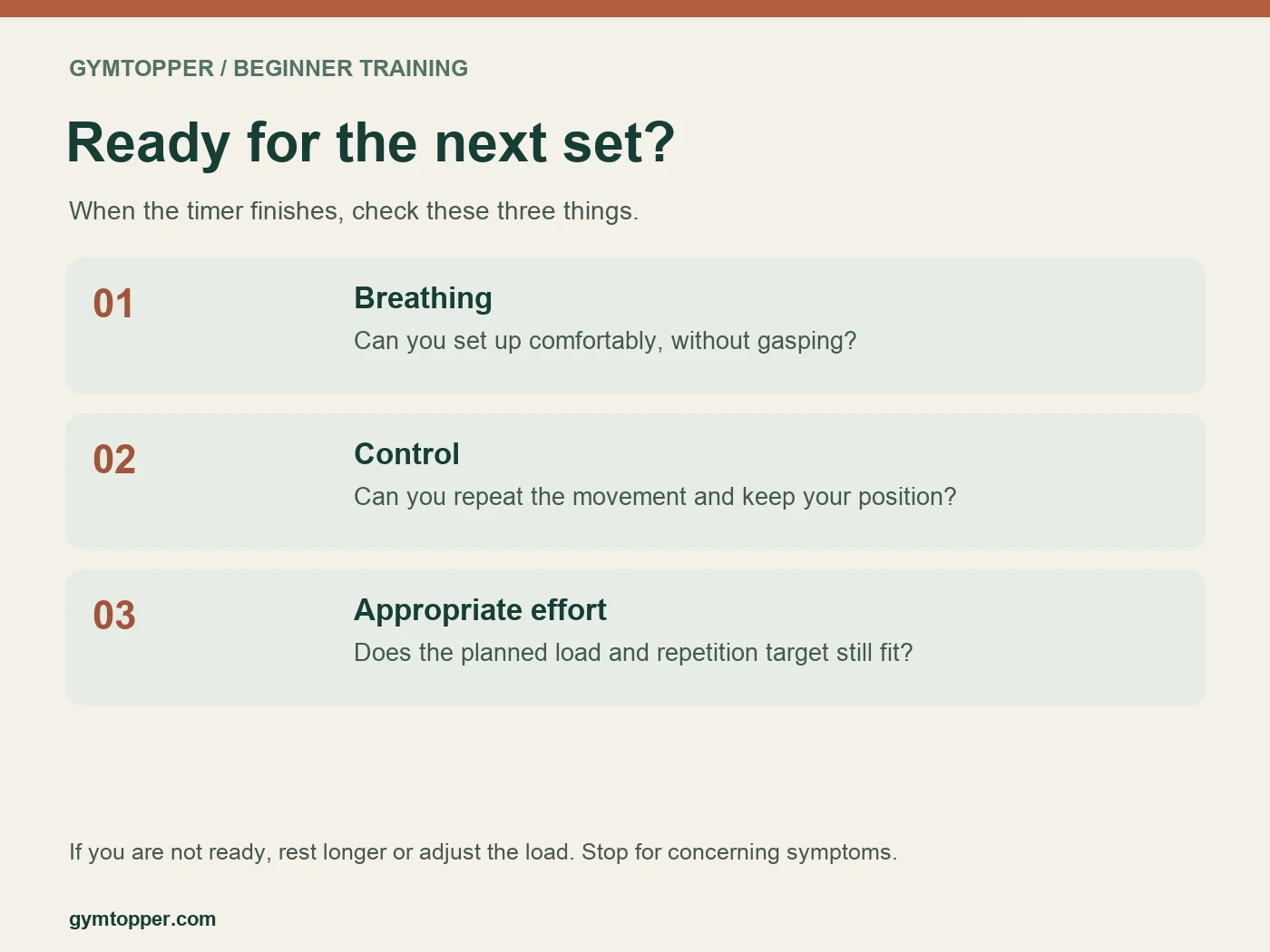
When the timer ends, pause for a quick check. You are deciding whether to begin another planned set, not diagnosing your recovery with a complicated score.
- Can I breathe comfortably enough to set up? If you are still gasping, wait longer. Comfortable breathing is a practical cue, not a guarantee that you are fully recovered.
- Can I repeat the movement with control? Think about balance, grip and the position you need to maintain. A shaky setup is a reason to reassess.
- Does the planned effort still make sense? If the last set was much harder than intended, consider more rest or less resistance instead of forcing the original number.
Feeling ready does not mean you must feel completely fresh. Some fatigue is expected. You are looking for enough readiness to perform the next appropriate effort, rather than waiting for every sensation to disappear.
A worked example: adjusting your rest time
Here is an invented training-log example, not a claim about a GymTopper test participant. Alex is learning a seated row and has chosen a load for three sets of eight to ten controlled repetitions.
- Set one: 10 repetitions, with a few more good repetitions probably available.
- After 60 seconds: only 6 repetitions before Alex starts leaning back to finish the movement.
- Before the next set: Alex extends recovery to 2 minutes and checks the seat and chest position.
- Set three: 8 controlled repetitions, stopping before technique deteriorates.
This pattern suggests that the short interval may have contributed to the drop. It does not prove the cause: familiarization, load selection, effort and normal day-to-day variation also matter. Next time, Alex starts with two-minute rests and records the results.
If performance still drops sharply, the next useful change may be a lighter load or a less demanding first set. Change one variable at a time when practical. It is much easier to learn from a log than from a vague memory that Tuesday felt “somehow heavier.”
For a simple way to record progress, use our progressive-overload guide. Keep rest intervals reasonably consistent when comparing sessions so that faster training is not mistaken for a loss of strength.
How rest fits into a beginner full-body workout
You can use different timer settings within the same session. The following example illustrates pacing, not a complete individualized exercise prescription. Choose familiar movements and resistance that you can control.
- Leg press: two working sets, resting about 2–3 minutes between them.
- Machine chest press: two working sets, resting about 2 minutes.
- Seated row: two working sets, resting about 2 minutes.
- A small accessory exercise: two working sets, resting about 1–2 minutes.
- A familiar core exercise: use enough recovery to repeat its position and breathing pattern comfortably.
Warm up first and allow time to change equipment. Our three-day beginner gym plan gives this pacing a broader weekly structure. If the equipment is unfamiliar, start with the beginner machine guide.
For a rough time budget, five exercises with two sets each create five between-set rest intervals. At two minutes each, that is ten minutes of rest—not twenty. You still need to budget for the sets themselves, warm-up, setup and movement between stations.
What if you only have 30 minutes?
Plan the session before walking onto the gym floor. Select a small number of useful exercises, prepare your equipment settings and decide which work matters most. Extra scrolling and indecision are often easier to remove than recovery you actually need.
If time is tight, consider fewer well-executed sets or exercises rather than cramming the original session into a race. Keep enough rest for your priority movements. A repeatable shorter session is easier to evaluate than a different improvised sprint every visit.
Alternating two exercises can save time, but it changes the workout. Moving from a row to a press is not complete rest, and both movements still involve fatigue. Beginners may find straight sets easier while learning equipment and technique. Avoid occupying several stations in a crowded gym.
See our 30-minute beginner workout for a compact starting point. Let the available time shape the plan, then use your rest intervals to carry it out.
Five common rest-time mistakes
- Using one interval for everything. A demanding leg exercise and a light curl do not have to share the same timer.
- Starting again because you feel watched. Gym etiquette means sharing equipment politely, not abandoning necessary recovery. Offer someone the chance to work in when it is practical and safe.
- Turning every break into extra exercise. Adding push-ups between pressing sets changes the fatigue demands. Use that deliberately within a program, not because resting feels unproductive.
- Changing the load and rest at once. When performance changes, you will have less idea which adjustment mattered.
- Assuming a bad set is a bad program. Sleep, stress, unfamiliar equipment and effort all affect a session. Look for patterns across several visits.
Frequently asked questions
Is 60 seconds enough rest between sets?
Sometimes, especially for light technique practice or an easier exercise. If the next set loses control or falls well below the planned repetitions, try a longer break and reassess the resistance.
Is resting three minutes too long?
No. Three minutes can be reasonable after demanding compound lifts. Whether it suits the session depends on effort, performance and available time. It is not automatically necessary for every set.
Should I rest less to lose fat?
Do not choose resistance-training rest purely to maximize sweating. Use it to support the workout’s purpose. Body-weight goals involve broader habits, nutrition and total activity; a shorter timer alone is not a reliable fat-loss strategy.
When should the timer start?
For consistency, start it when you finish the set and safely put the weight down or return the machine to its resting position. Use the same approach each session. Normal setup time before the next set is part of the practical interval.
Should beginners train through dizziness?
No. Stop the exercise and get to a safe position. Dizziness, chest pain, faintness or unusual shortness of breath should not be treated as a timer problem. Seek appropriate medical help; severe or persistent symptoms need urgent assessment.
Your next-session plan
Choose one main exercise and start with a two-minute rest. Record the load, repetitions and a brief note about how controlled the sets felt. Add recovery if the next effort is rushed; adjust the resistance if it is unsuitable. After a few sessions, keep the interval that supports repeatable work within your schedule.
You do not need perfect timing to make progress. You need a sensible plan, enough recovery to follow it and the patience to learn from what actually happens. Set the timer, take the break, and let the next set do the talking.
Sources and editorial notes
- Singer et al. (2024): systematic review and Bayesian meta-analysis of rest intervals and muscle hypertrophy.
- Schoenfeld et al. (2016): one-minute versus three-minute rest in trained men.
- American College of Sports Medicine (2009): progression models in resistance training for healthy adults.
Written for GymTopper by Jordan with AI assistance. This is a research-informed educational guide, not a hands-on study or an individualized training prescription. The timing chart, sample session and training log are editorial examples. Featured artwork is AI-generated; the infographics are original GymTopper graphics. See our editorial policy and author information.
Leave a Reply